


Blog
Inside the State-of-the-Art Stadiums of the 2026 World Cup: A Lesson in Optimizing Every Space

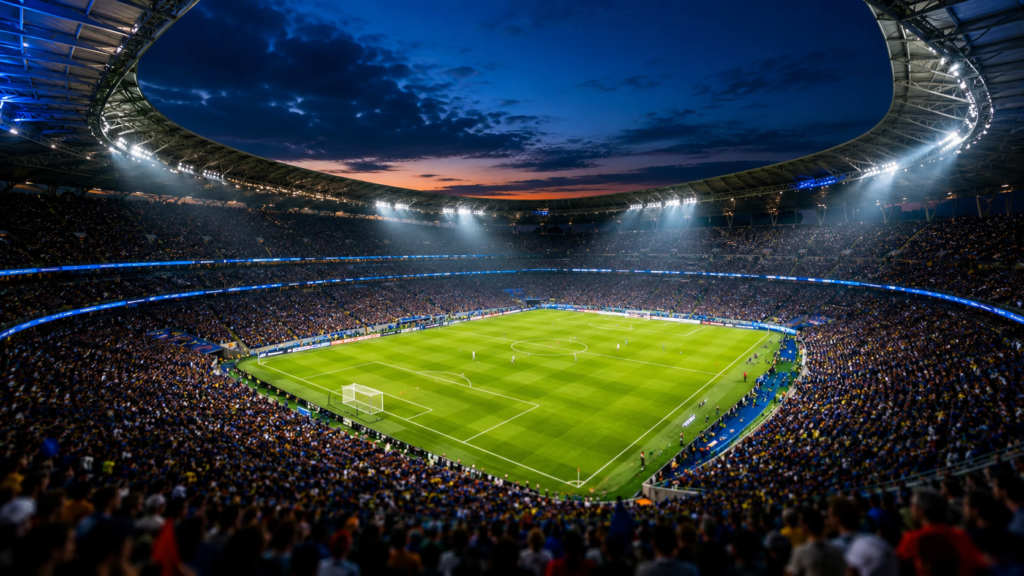
The World Cup arrives only once every four years, and in 2026 it reaches a scale the tournament has never seen before. From 11 June to 19 July, matches will be played across the United States, Canada, and Mexico, with 48 teams contesting 104 fixtures in 16 host cities, and the final at MetLife Stadium is forecast to reach a global audience of more than a billion people. A spectacle of that size leaves nowhere for a host venue to hide. Every operator, architect, and developer attached to these buildings has had to take an honest look at whether their stadium can deliver in front of a worldwide audience.
2026 World Cup Stadiums: How These State-of-the-Art Venues Were Upgraded for the Tournament
The venues chosen to stage this tournament sit among the most sophisticated sports buildings anywhere in the world, and yet each of them still had preparation to do. Bringing the World Cup to an American stadium involves a great deal more than laying a pitch inside an NFL arena. It calls for natural grass systems, reconfigured premium seating, and building services adapted to satisfy the precise standards FIFA sets. The grass conversion was a significant undertaking in its own right. Mercedes-Benz Stadium, AT&T Stadium, MetLife, SoFi, and Lumen Field were each fitted on a temporary basis with natural turf laid over their regular playing surfaces, drawing on what FIFA describes as six to seven years of research. SoFi had to lift its pitch by roughly 30 inches and reshape the seating bowl to accommodate a full-size soccer field, while AT&T Stadium committed close to $300 million to renovation work that included an overhaul of its premium areas and the addition of new rooms to meet FIFA’s requirements for medical, dignitary, and press facilities.
The lesson in all of this is that state-of-the-art is not a label a building is awarded once and keeps for good. It is a benchmark that has to be met again and again across the entire venue, and that extends to the areas no broadcast camera ever settles on. Nowhere is that clearer than in the washroom.
Touchless Washroom Technology That Improves the Stadium Fan Experience
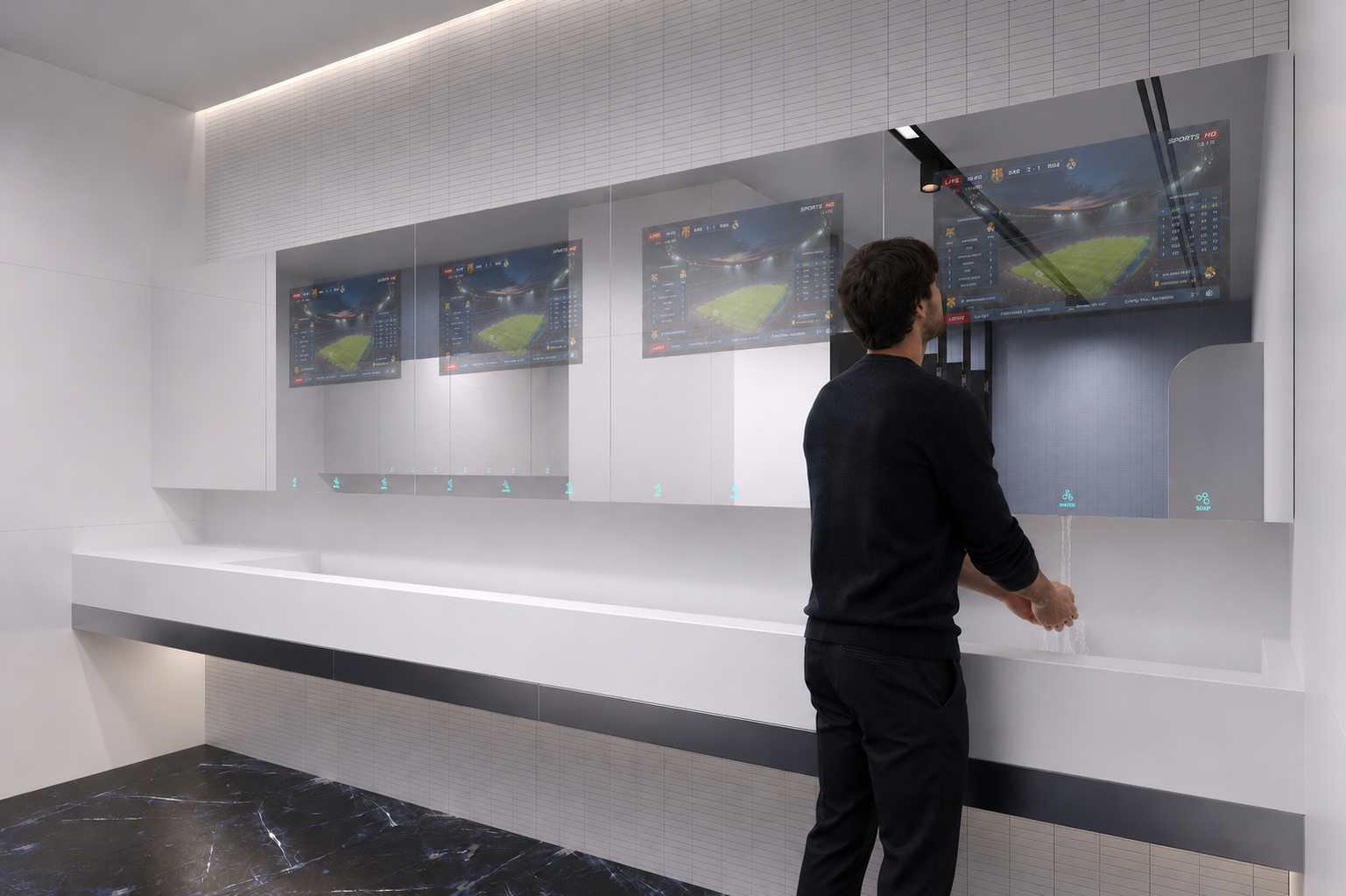
Think about the supporter who put money aside all year for this. World Cup tickets are scarce and costly, the sort of occasion someone counts down to for months, and at last the day has come. Then, somewhere past the hour mark, the need for the washroom becomes impossible to ignore. The anxiety on the walk there is not how long the queue will be but the prospect of missing the goal that settles the tie. Stern’s SWAR TV wash station removes that anxiety. It is a lockable, all-in-one sanitary cabinet, and behind its mirrored front sits an award-winning 23.5 inch monitor capable of showing live match data, the broadcast feed, wayfinding, or advertising. Infrared sensors operate the faucet, soap dispenser, and high-speed hand dryer, with illuminated LED pictograms directing the user at each step, so a guest can wash their hands, stay with the game, and head back to their seat without that sinking sense of having missed the decisive moment. Inside a venue, the washroom mirror works as a service point and as valuable media space at the same time.
Touchless Hygiene Solutions for Busy Stadium Restrooms
Now imagine that same washroom once twenty thousand visitors have moved through it over the course of an afternoon. Every shared tap and handle has already met thousands of hands, and in a crowded venue that reality governs both how clean the space feels and how safe it really is. This is precisely the problem Stern’s Total Touchless Experience, a 360-degree approach to sustainable hygiene, was designed to solve. The whole sequence runs hands-free, beginning with the IR sensor-activated faucet and soap dispenser and continuing through to a high-speed hand dryer that finishes the job in under fifteen seconds. With Stern’s patented Touchless Cubicles, even the door responds to hand-proximity sensors. A guest simply presents a hand to a discreet LED, which reads green when the cubicle is vacant and red when it is engaged, housed in a fitting that looks much like a conventional door lock. Because no manual tap is there to splash, counters and floors stay dry, which takes away both the slip hazard and the standing water that makes a busy washroom feel uncared for. The cubicles are constructed from 42mm floor-to-ceiling High-Pressure Laminate, a material that is naturally antibacterial and stands up to water, steam, chemicals, impact, and even cigarette burns, so the room holds its finish through weeks of unrelenting use.
Washroom Occupancy Indicators for Crowd Management at Busy Events
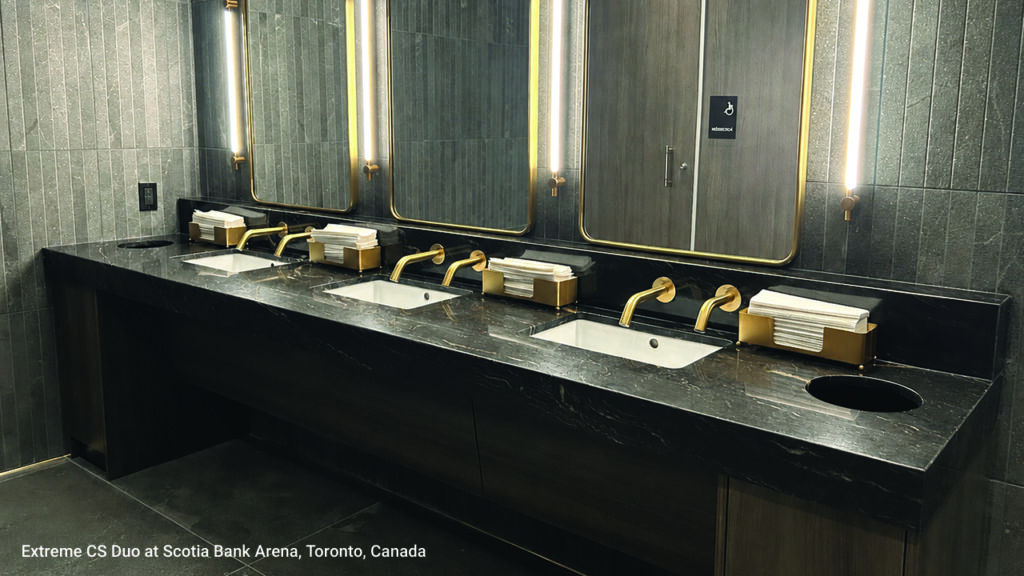
The toughest fifteen minutes in any stadium washroom come at half-time, when demand lands in a single wave and every guest is racing to be back in their seat before play resumes. The real frustration is seldom the crowd itself. It is standing before a row of shut doors with no way of telling which is about to open. Stern’s Top Occupancy Indicators tackle that head on, with smart LED indicators built into the handle and lock and repeated at the top of each cubicle, so availability can be read from right across the room in the same way an airport signals open gates. In larger facilities, the VacantView Washroom Display shows real-time occupancy at the entrance and has been named a Best of BDNY Product Winner for this kind of crowd management. There is also an optional setting that uses white for vacant and red for engaged to assist users with colour vision deficiency, along with a safety-unlock function that gently releases any door left locked for an unusually long time. Guests can see at once where to go and keep moving, and the queue clears before kickoff.
Low-Maintenance Washroom Design for Venue Operations and Cleaning Teams
It is worth sparing a thought for the cleaning team, who are handed those same fifteen minutes to turn around a washroom an entire section has just used, and who stay on their feet for the full duration of the event. Stern’s design sets out to keep that workload realistic. The cubicles include a dedicated service mode for cleaning, triggered by holding both hands over the door sensor, which holds the door open for two minutes with the sensors switched off so staff can work undisturbed. The SWAR multifeed system links several soap dispensers to a single 6-litre reservoir, so refilling becomes one quick visit to a central point rather than a round of every unit, and a soap refill indicator flags when attention is needed before any dispenser runs dry. Installation and ongoing upkeep stay straightforward as well, because the cubicle panels are pre-wired during manufacturing, a single 15-volt transformer drives up to four cubicles, and no ceiling reinforcement is needed. Dry floors mean far less mopping between rushes, and touch-free operation with few moving parts keeps maintenance and call-outs low across a tournament that runs for weeks.
Water-Saving LEED v5 Washroom Fixtures for Sustainable Venues
On its own, a single low-flow faucet saving a fraction of a litre amounts to very little. Multiplied across hundreds of thousands of uses over a month-long event, it turns into one of the more consequential decisions made anywhere in the building. Within LEED v5’s Water Efficiency category, Stern fixtures can contribute up to six points. The touchless faucets offer an adjustable flow as low as 0.15 gpm for water savings of up to 70 percent, while the standard 0.35 gpm setting still delivers 30 percent. Ultra-low-flow urinal valves at 0.125 gpf reduce usage by 75 percent, and single-flush toilet valves bring consumption down to 1.1 gpf. Stern’s Noble 2032 dual-flush valve adds a vandal-resistant AISI 316 stainless cover together with a 24-hour hygiene flush that protects the trap seal through quieter spells, and the SWAR can be specified with Stern’s certified thermostatic mixing valve, which meets ASSE 1070, NSF 371, TMV3, and DVGW standards. For player and staff facilities, shower panels save 47 percent at just 1.06 gpm. For an operator, those numbers add up to a utility bill closer to that of a small town than a single building. For an architect, they represent points toward certification and a sustainability story worth telling.
Optimising High-Traffic Venues Long After the 2026 World Cup
If the 2026 World Cup makes one thing plain, it is that a great venue is never genuinely finished. It is optimised on a continuous basis, from the turf and the grandstands down to the rooms most people give no thought to until something goes wrong. A washroom is never going to trend the way a retractable roof does, and yet it is the one space every single visitor uses, and the one they will mention on the journey home if it has let them down. The buildings hosting the world this summer treated state-of-the-art as a commitment to the whole venue, and the same touchless, sustainable, and intelligent engineering is ready for whatever you are designing next, whether that is an airport, an arena, a convention centre, or a flagship hotel.
 Boreal
 Classic
 Condor
 Cool TF
 Csaba
Csaba Dolphin
 Easy
Easy Elite
Elite Extreme
 Green
Green Quadrat DM
 Smart
Smart Swan
Swan Touch Free
 Trendy
 Trendy T
 Tubular DM
 Apollo AL
 Apollo Free
 Apollo Medical
 BTM
BTM Cubica
 D28
D28 Extreme CS
 Malmo
Malmo Tubular
 Tubular 1000
 Tubular Wave DP LE
 Washfree 1000
 Green Time


